Integration of Modular Energy Storage in the Distribution Grid
A novel architecture for active buildings using the iBatt modular smart battery concept, enabling voltage and frequency support through power electronics-based grid connection.
Modular Energy Storage for Active Buildings
This paper introduces the iBatt concept — a modular smart battery capable of interfacing Li-Ion battery modules to the distribution grid. Embedded within the multihome scenario, the system proposes a novel architecture for integrating active buildings into the grid through shared DC bus infrastructure, bidirectional interlinking converters, and coordinated building-to-building energy exchange.
Scalable Scenarios
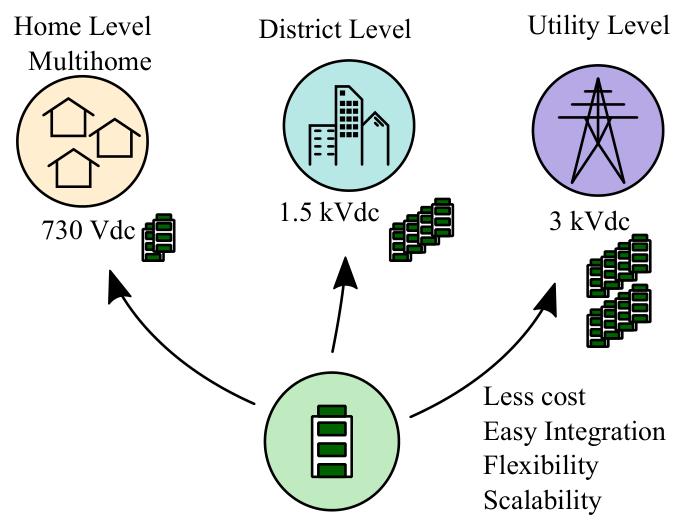
The TALENT project defines three deployment scenarios with increasing voltage and power levels, all built from the same iBatt modular units: home-level multihome systems at 730 Vdc, district-level systems at 1.5 kVdc, and utility-scale systems at 3 kVdc. This scalability enables both manufacturers and end users to optimise energy storage sizing while sharing fixed and variable costs.
Multihome Architecture
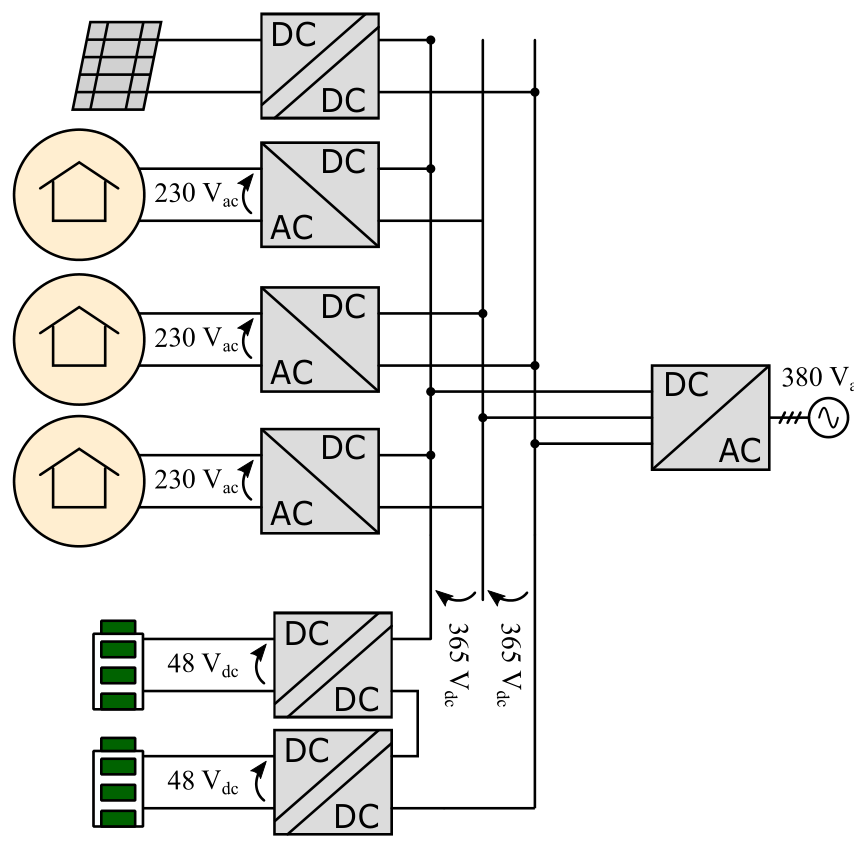
The multihome system is a multiport modular power electronic converter (MMPEC) designed for integrating energy storage and renewable sources at building level. Cost reduction is achieved through shared investment among building shareholders and through system modularity that enables optimised storage sizing.
System Components
The multihome architecture comprises four key elements: a bidirectional interlinking converter based on a three-level NPC topology with Virtual Synchronous Generator (VSG) control; two series-connected iBatt modules creating a 730 Vdc bus; modular load-side converters for individual dwellings and common building services; and a small-scale PV installation feeding the shared DC bus.
Building-to-Building Control
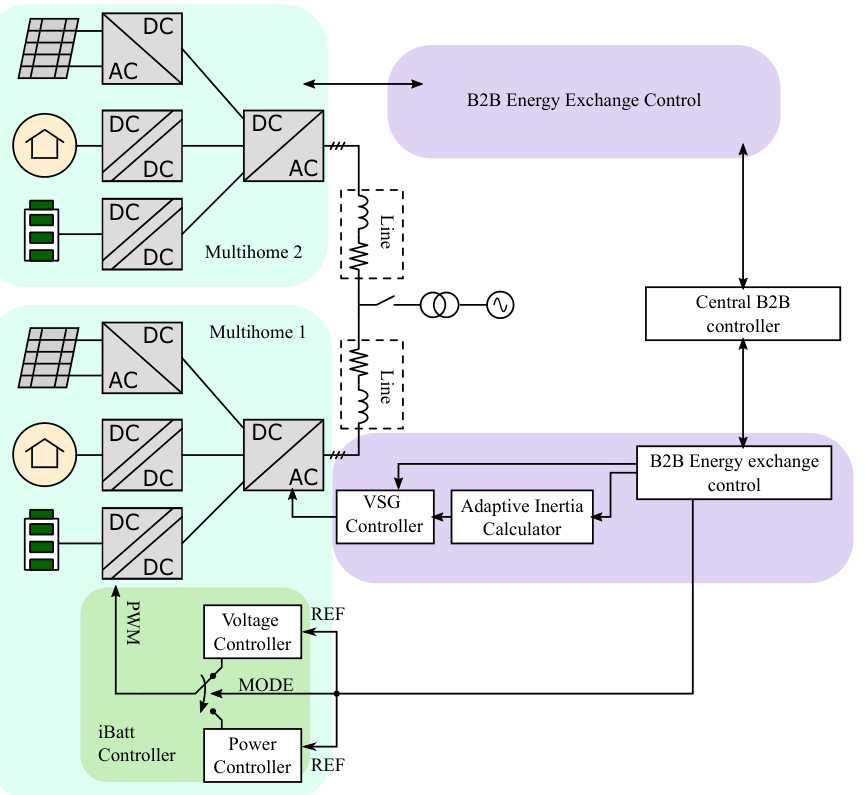
At the heart of the multihome scenario, the B2B energy exchange employs a VSG-based control system designed to minimise oscillations in frequency and voltage during load changes. This approach extends battery life by reducing unnecessary charge/discharge cycles. The iBatt operates in two roles: independently controlling DC bus voltage, or acting as a controllable element directed by the central B2B controller.
Laboratory Validation
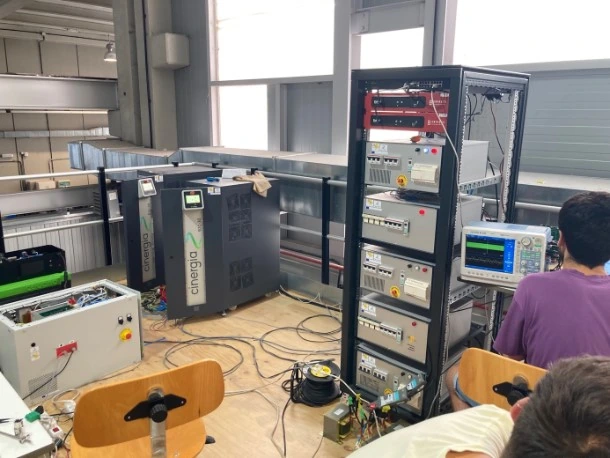
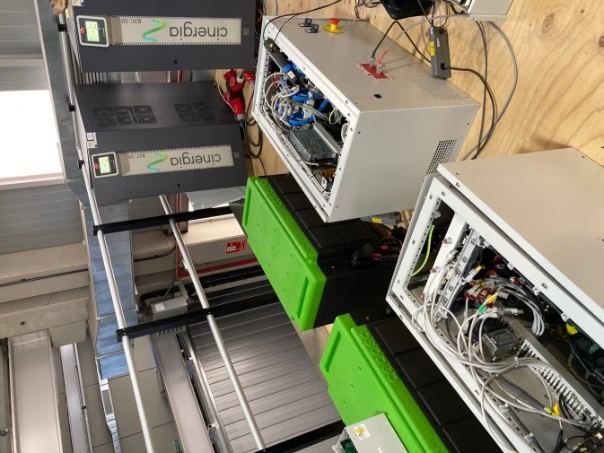
The multihome scenario was recreated at the LEMUR research group laboratories at the University of Oviedo. Critical parameters including current, voltage, and power were measured across various operation modes at multiple power rates (10% to 100%), standby conditions, and fault scenarios.
Voltage Control Mode
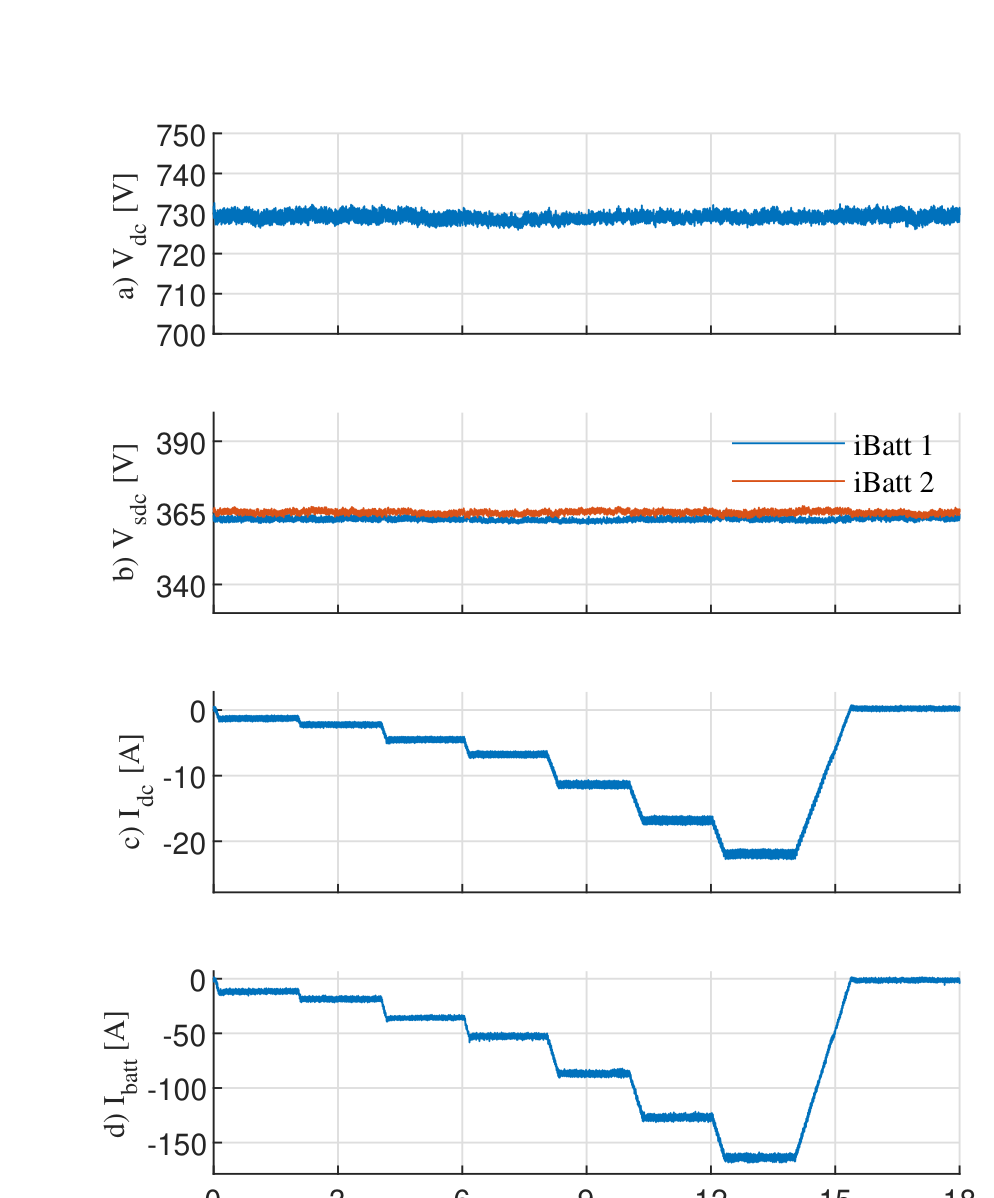
In voltage control mode, both iBatt units operate as voltage sources, each regulating to 365 V for a stable 730 V DC bus. Programmable loads were incrementally applied from 10% to 100% power as disturbances. The bus voltage remained within ±5 V of nominal, confirming precise control even under varying current demands.
Power Control Mode
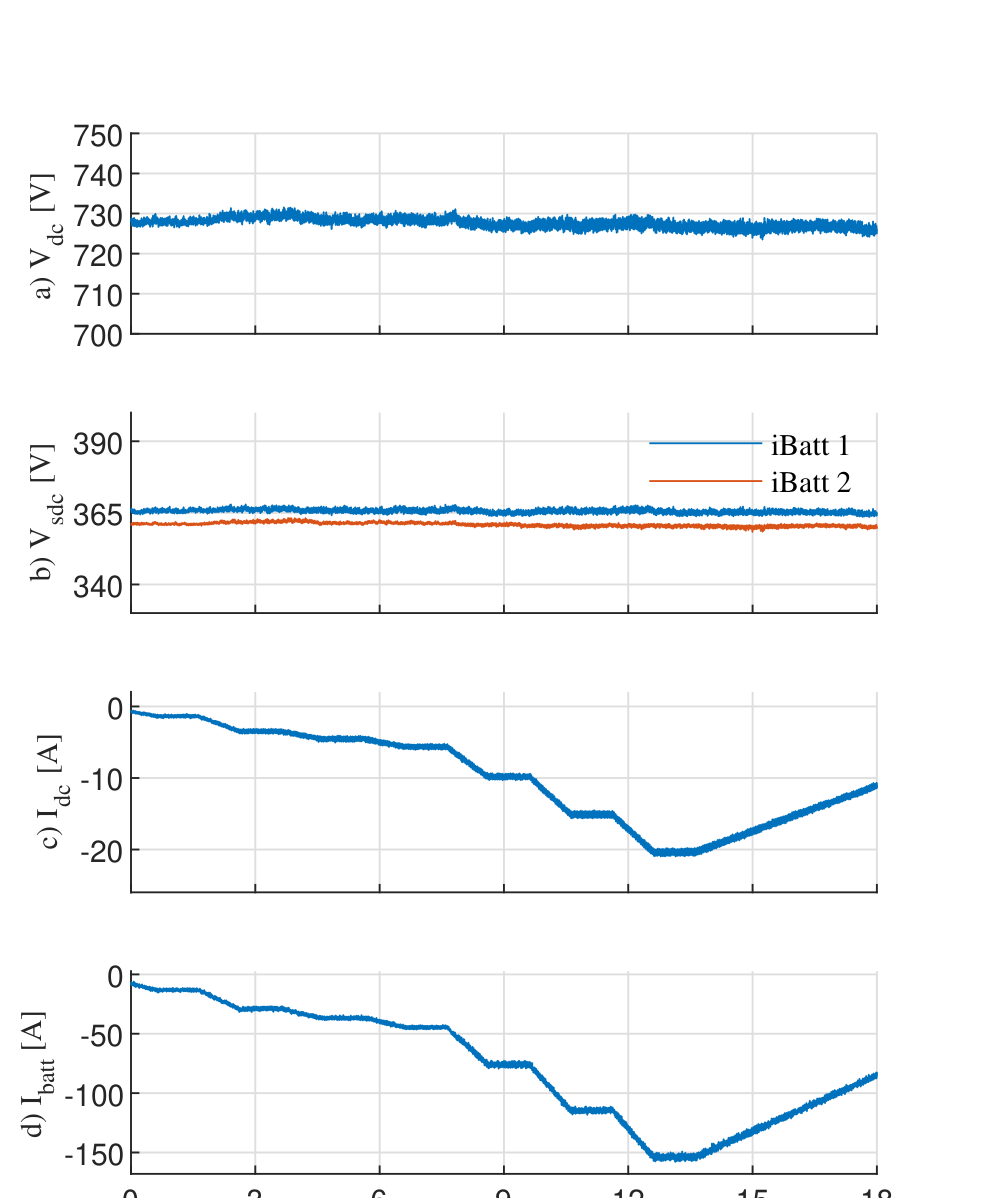
In power control mode, the NPC converter takes over DC bus voltage regulation. One iBatt operates in current mode while the other balances voltages. Power transitions are programmed with controlled ramps of 1.6 kW/s, producing smoother transients compared to voltage mode. This mode enables the iBatt to respond to external commands from the B2B controller.
Interlinking & iBatt Combined Operation
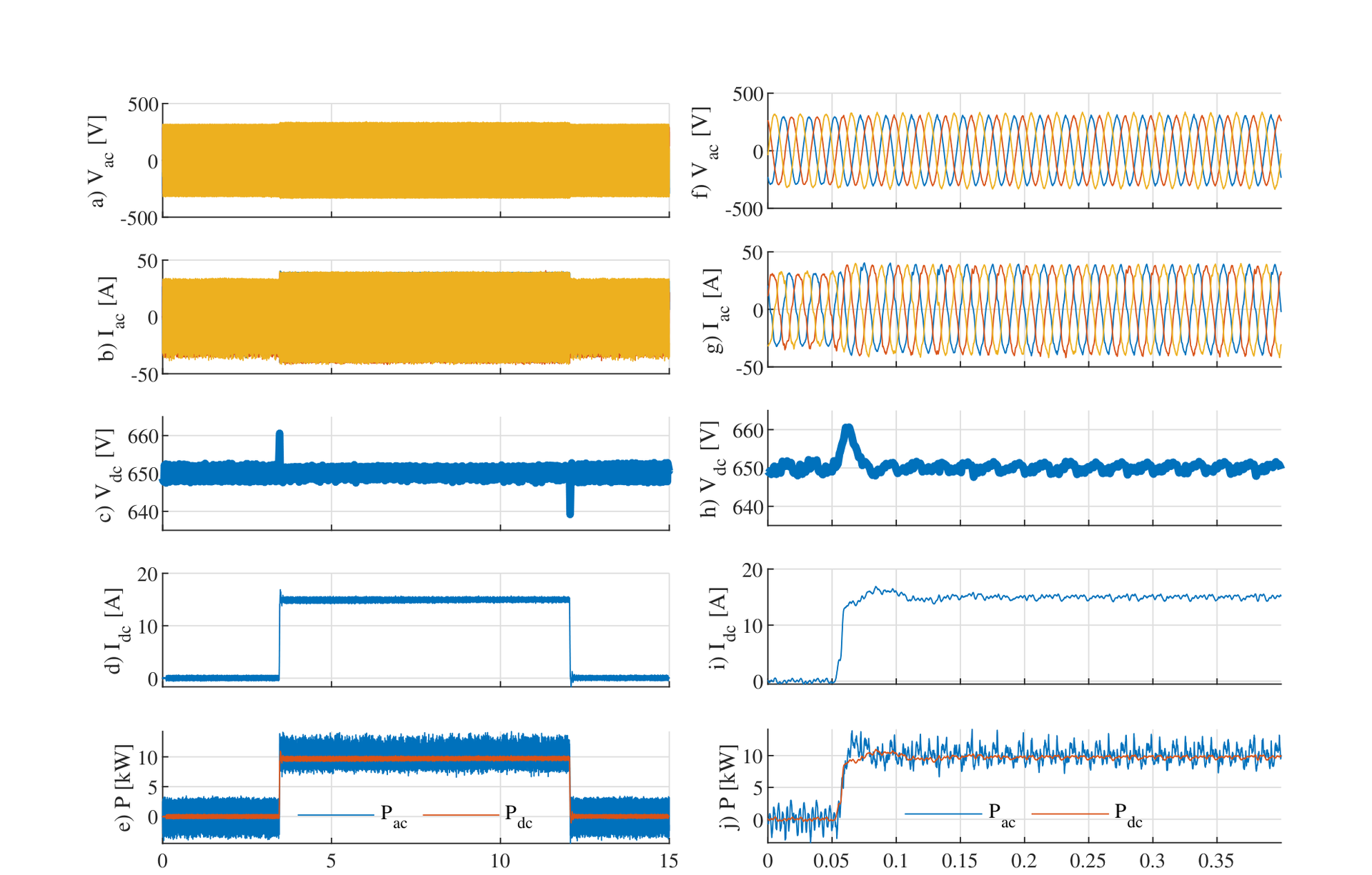
With both iBatt units in voltage control mode, a step-type 10 kW load was applied to evaluate system robustness. The power demand rose at a slew rate of 0.5 kW/ms, and the system maintained full DC bus stability throughout. The interlinking converter seamlessly managed power exchange with the AC grid, confirming the system’s readiness for complex real-world operation.
Key Experimental Results
(stable ±5 V)
(at 1C load)
(in 20 ms)
Relevant Environment
Efficiency Analysis
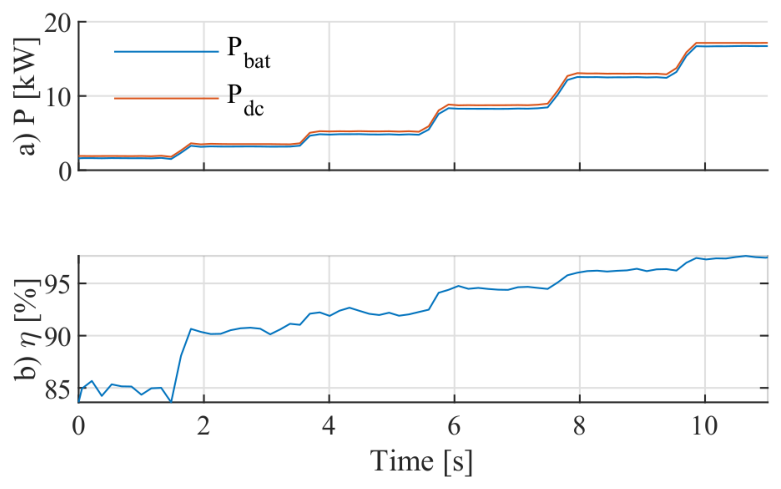
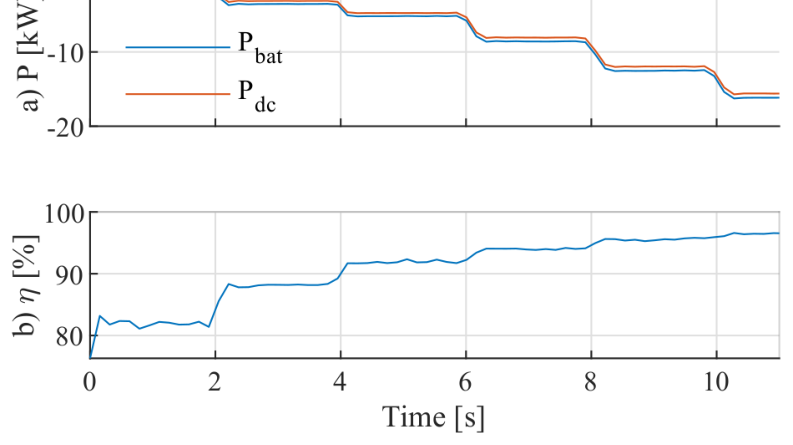
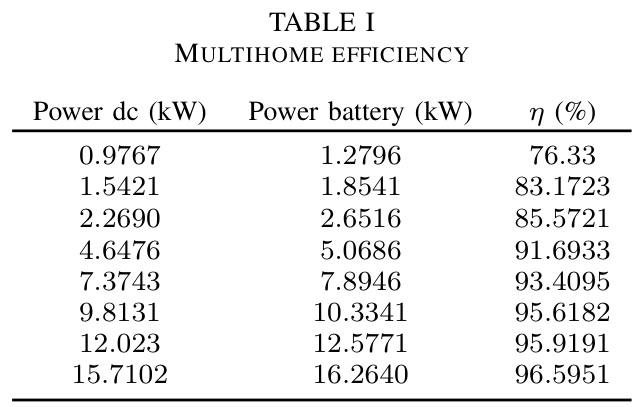
The system efficiency was evaluated across the full power range during both charge and discharge operation. At low loads, the iBatt power electronics operate in hard-switching mode, producing higher switching losses and an efficiency around 85%. As current increases, the semiconductors transition to soft-switching mode, driving efficiency up to 96.6% at rated (1C) power. The symmetrical converter topology yields near-identical performance in both charge and discharge directions.
Network Scalability
The modular nature of the iBatt concept opens new research paths for buildings to actively contribute to the energy transition. By seamlessly accommodating energy generation and storage, the system minimises implementation costs while optimising the energy storage system. The architecture is validated for the multihome scenario and extensible to district and utility scales through the TALENT project framework.